
Updated
Superstitions attach luck, danger or protection to everyday objects and events. Their stories can be interesting without being reliable predictions. A documented tradition tells us that a belief was recorded; it does not establish that a cat, date or charm controls what happens next.
Beliefs also vary within countries, families and generations. The six examples below are selected for their traceable sources, not as a survey of what every person in a country believes. Where an origin is uncertain or an account is legendary, that distinction matters.
Three checks for a folklore story
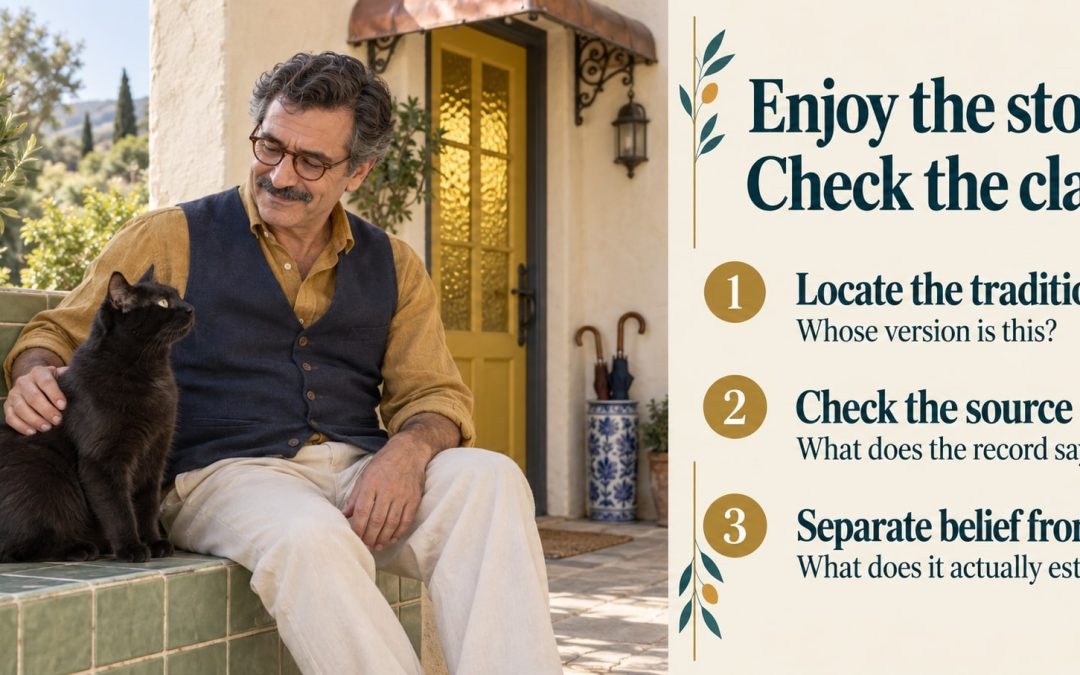
The cover guide offers a way to read an intriguing claim without turning it into a fact:
- Locate the tradition: whose version is this? Look for a community, place, period or named narrator. Avoid treating a whole population as if it shared one belief.
- Check the source: what does the record say? A museum object, dated archive or folklorist’s discussion can help establish context. A retelling may add details the source never included.
- Separate belief from fact: what does it actually establish? A protective charm shows an intended meaning. It does not prove that the charm prevents harm.
Six examples with sources and context
1. Friday the 13th: an origin story needs evidence
Friday the 13th has an unlucky reputation in familiar English-language popular culture. Explaining exactly how that reputation developed is harder than repeating a dramatic story about it.
Folklorist Stephen Winick’s Library of Congress discussion examines possible origins and the stories people tell about those origins. He distinguishes historical evidence from later speculation, including a frequently repeated Knights Templar connection.
What this supports: The superstition has a history worth investigating. A memorable explanation is not automatically its proven origin, and the date itself is not a reason to expect personal disaster.
2. The Turkish nazar bead: the meaning of a motif
The blue eye-shaped nazar boncuğu is a recognizable example of an object associated with protection from the evil eye. GoTürkiye’s account of Turkish handcrafts describes its use on doors, at storefronts and in souvenir forms such as ornaments and keyrings.
What this supports: The motif has a documented cultural and decorative role. It does not show that a compliment causes damage, or that someone who envies you can make an object break. Ask what an ornament means to its owner instead of assuming.
3. Cats: meanings can contradict each other
Black cats have not always carried one universal meaning. The Museum of English Rural Life’s folklore resource describes both lucky and unlucky associations, including black cats as good-luck images on English greetings cards.
A different example is the Japanese beckoning cat, or maneki-neko. A British Museum record for a ceramic cat amulet made in Japan in 2000 describes its raised paw as associated with luck and wealth. That particular object is white; it should not be used as evidence about every black-cat tradition.
What this supports: Similar animals can carry different symbolic meanings. A cat’s colour does not make it deserving of fear or mistreatment.
4. The Tower ravens: a legend attached to a place
Historic Royal Palaces describes the Tower of London legend: if its six resident ravens leave, the Tower and kingdom will fall. Its telling also links protection of the birds with Charles II.
What this supports: This is a specific site’s legend, not evidence that ravens generally bring bad luck in Britain. Describing the story as a legend preserves its character without presenting a royal catastrophe as a testable promise.
5. Horseshoes: an everyday object becomes a charm
The Museum of English Rural Life resource also describes the tradition of displaying a horseshoe above a door, with the opening upward, to hold good luck. It connects the symbol with an ordinary object from working life.
What this supports: A practical object can acquire another meaning in a household or greeting card. The recorded orientation is one version of the custom, not a rule that everyone must follow to avoid misfortune.
6. Argentina’s presidential godchild: check the archive
A claim sometimes retold alongside seventh-son folklore says a president adopted a child to stop him becoming a werewolf. The Casa Rosada record dated 22 December 2014 says something more specific: then-president Cristina Fernández met Iair Gabriel Tawil, described as a presidential godchild, together with his parents and siblings.
What this supports: The documented event concerns presidential godparenthood. The record does not describe adoption, a grandchild or a ceremony to prevent a supernatural transformation. Keep the event and the sensational retelling separate.
Enjoy traditions without making them instructions
A family saying, ornament or story may matter because of memory, humour or shared identity. You can ask where someone first heard it, whether their family follows it literally, and whether they know a different version. Curiosity works better than assuming either that everyone believes it or that nobody takes it seriously.
If you want to use a meaningful object in your own routine, our crystal symbolism guide separates a personal reminder from a promised outcome. For claims made during a reading, the reading-accuracy guide offers ways to record and check what was actually said.
Use ordinary evidence for decisions about health, safety, relationships and money. A superstition is not a diagnosis, proof of another person’s intentions or a reason to pay someone to remove a supposed curse.