
Updated
Ajna, often called the third-eye or brow chakra, belongs to a spiritual framework. A symbolic description can help you understand a teaching. It does not establish an extra organ of sight, a health diagnosis or an ability to predict the future.
This page is a reference for reading chakra descriptions and evaluating the claims attached to them. For an optional reflection exercise and practical precautions, see our separate guide to third-eye practice.
One source, with its context intact
In Himalayan Academy’s Merging with Śiva, Lesson 285, Ajna is presented as the sixth centre, associated with the brow, two petals and lavender. The text interprets it through a religious account of consciousness and divine sight.
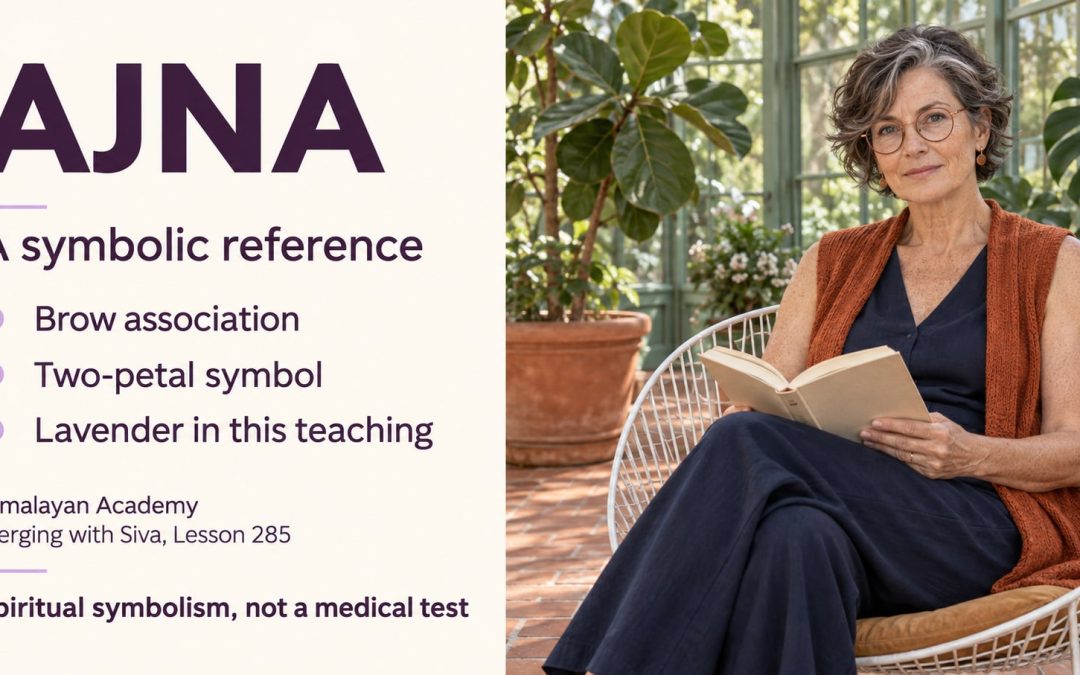
The featured graphic summarizes three associations from that particular account. It is our reference design, not an anatomical diagram or a statement that every teacher uses the same system.
- Brow association
- The location used in this spiritual description.
- Two-petal symbol
- Part of the source’s symbolic language.
- Lavender in this teaching
- A colour attributed by this source, not a colour you must see.
When another chart gives a different colour or interpretation, ask which text, teacher or practice it follows. Do not diagnose yourself from the difference. A preference for violet clothing or noticing triangles in everyday objects does not establish that anything in your body is opening.
Our seven-chakra reference gives a broader overview. Read an individual teacher’s explanation in context before borrowing a practice or treating a chart as a set of instructions.
Translate the claim before deciding what it means
“Insight” can mean more than one thing
A teacher might mean noticing an assumption, contemplating a religious idea or receiving hidden information. Ask them to specify which. Better understanding your own preferences is different from knowing what another person thinks or what will happen next.
“Open” needs a clear definition
Is it a metaphor, a religious description or a promised result of a paid session? A deadline such as one month does not become reliable because it sounds precise. Ask how the result would be established and what happens if the promised change does not occur.
“Blocked” is not an explanation by itself
Fear, an unsettling dream or not seeing images cannot establish a chakra blockage. Describe the actual difficulty first: perhaps you need more information, dislike an exercise or are struggling with sleep. Those descriptions make it easier to choose an appropriate next step.
Crystals and Reiki do not verify a chakra diagnosis
You can appreciate a crystal’s appearance without needing to purchase it to repair yourself. The claim that a particular stone will produce visions requires evidence beyond a colour association or sales description.
NCCIH’s Reiki overview reports inconsistent, often low-quality research and no clear demonstration of effectiveness for a health-related purpose. It also says scientific evidence does not support the proposed energy field. That does not support presenting Reiki as a proven remedy for a supposedly blocked third eye.
If considering a session for personal or spiritual reasons, ask about the activity, total price, touch and consent, and your ability to stop. Feeling uncertain about a claim is a reason to ask questions, not proof that you need more treatment.
Flashes and voices need a different response
Do not use a chakra chart to explain new visual symptoms. The NHS advises urgent assessment for first-time or sudden flashes or floaters, a sudden increase, a dark curtain or shadow, accompanying blurred vision or pain, or symptoms after eye surgery or injury. Seek an urgent eye-care appointment or local urgent medical advice.
If you hear voices or experience things that seem present when others do not, seek medical advice promptly. The NHS guidance on hallucinations recommends urgent help and emergency care for sudden confusion, rapidly worsening symptoms, voices directing harm or immediate danger. These experiences can have different causes; this article cannot identify one.
Make a useful learning note
Instead of scoring your spiritual progress, keep a short source note. These questions work for a book, video, class or conversation:
- Where did I read it? Record the author or teacher and the specific passage.
- What kind of statement is it? Distinguish a symbol, a proposed exercise and a claim about health or events.
- What is still unclear? Write one question before adding your own interpretation.
- What will I do with it? Choose whether to read further, ask for clarification or leave the idea aside.
You do not have to see lights, buy crystals or reach a special state to learn about a spiritual tradition. Understanding the source and the limits of its claims is a worthwhile result.