
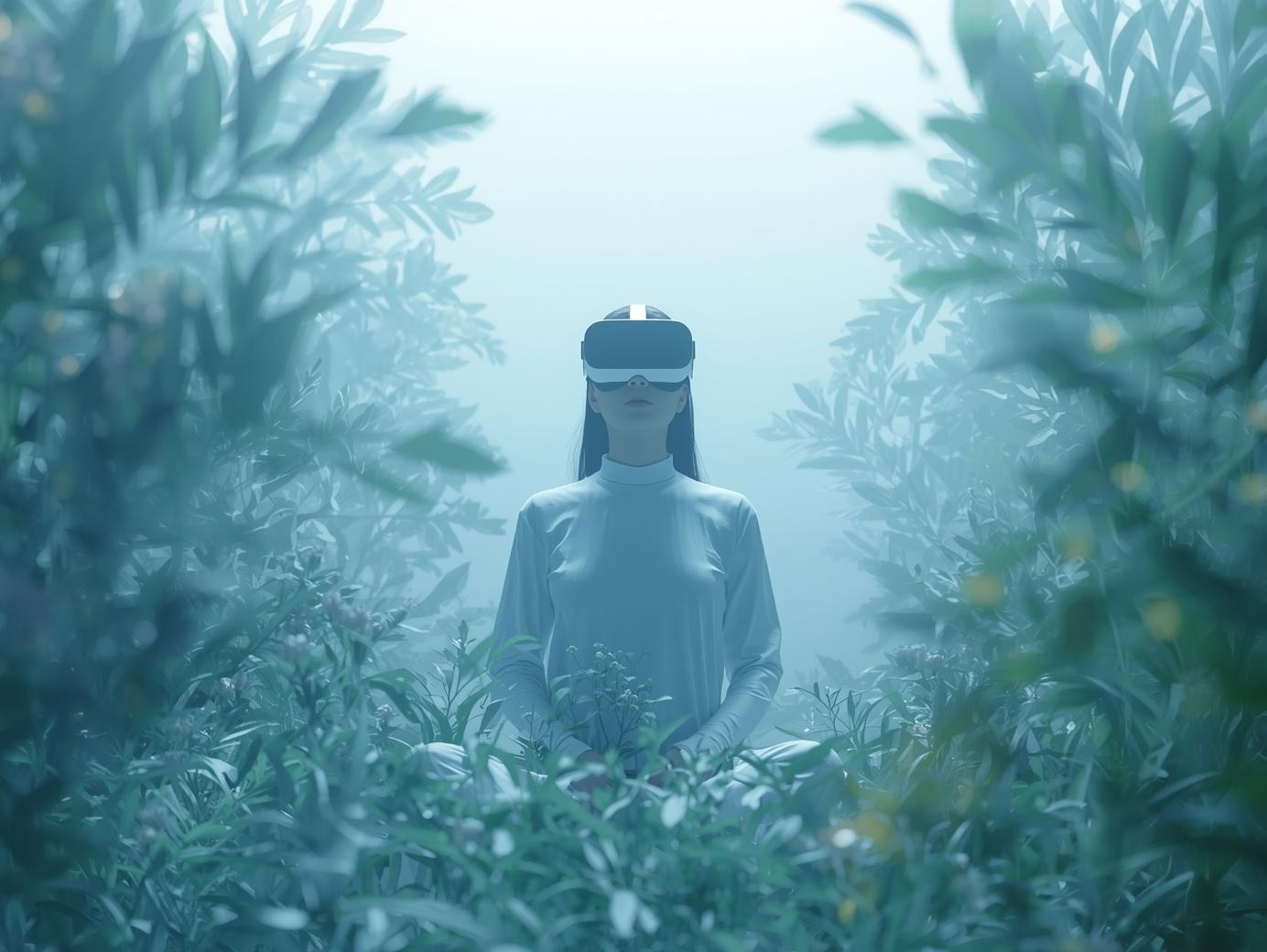
VR Mindfulness in the Present
Have you ever been meditating and your phone rings, and it completely throws you out of your deep meditation? If you do, then you might want to understand how virtual reality can be appealing. You can put on the VR headset. If your emails come through, a notification to check the news or a text comes through, you won’t have the impulse to check it, but instead you’ll have a quiet place where you can look at a sky or a minimalist temple that asks nothing of you except for you to be quiet and to notice what’s going on around you.
VR can change what you are seeing around you faster than your mind can even comprehend to question it. The question is whether VR can stimulate mindfulness or if it only gives people a place where mindfulness is easier to get to.
Research from PMC suggests that VR can support mindfulness practices for people, especially people who are more engaged, and can help to create a sense of presence that makes attention-training something doable. But the same things that help someone to focus can also cause things like motion sickness for some. And another problem with VR, since it is such a fast and easy tool, it can become a shortcut habit instead of a skill builder that helps people to escape instead of change.
The best way to use VR is as a system for mindfulness training. The results, of course, will depend on the design of the experience and the intention that the user has.
Understanding What Mindfulness Is
Mindfulness is often sold like a quick fix. Take a deep breath, clear your mind, stop overthinking, and suddenly you’re calm, centered, and immune to doom-scrolling. That version sounds nice, but it isn’t very real.
In everyday life, mindfulness is much simpler and more practical. It’s about paying attention to what’s happening right now, with a little more openness and a lot less judgment. It doesn’t mean you stop having thoughts. It means you notice your thoughts without treating every single one like an emergency that needs immediate action.
Most evidence-based mindfulness approaches focus on a few core skills. One is attention training, where you notice when your mind wanders and gently bring it back to something steady, like your breath, a sound, or how your body feels. Another is meta-awareness, which is just recognizing what your mind is doing in the moment. You might notice, “Oh, I’m worrying,” or “I’m replaying that conversation again,” without getting pulled all the way into it. There’s also emotion regulation, which means allowing feelings to be there and learning how to respond thoughtfully instead of reacting on autopilot.
It’s also important to be honest about the fine print. Mindfulness and meditation are usually low risk, but they’re not completely neutral for everyone. Some people experience increased anxiety or low mood, especially if they practice without support or jump in too fast. The U.S. National Center for Complementary and Integrative Health has summarized research showing both the benefits and the potential downsides, along with the importance of proper guidance.
This really matters when you are using mindfulness with technology, such as using virtual reality. VR can make sensations more intense, and this can make the emotional responses stronger. For some people, this can be helpful and can keep them grounded, but for some, like those who get dizzy or panic easily, it can work the opposite. Just like being mindful, support and information can make all the difference for someone who is choosing to use this.
What VR Can Simulate
When people talk about “simulate mindfulness,” they often think about a VR that can get you into a meditative state the way that a light switch turns on lights. The truth is, VR can simulate conditions that support mindfulness practice, but this doesn’t mean it can get you to that state.
Reducing Competitive Stimuli
Mindfulness means paying attention, and attention is a context-sensitive situation. VR can help to remove distractions such as notifications, social pressures, visual clutter, and other things, and can replace them with a single scene.
This is important because those who are beginners often have a hard time being mindful because their environment is too busy, loud, or full of triggers that cause them to want to plan or worry about things. VR can help to reduce these outside stimuli.
How VR Can Support Attention
One thing VR can do well is create a sense of presence. Presence is that feeling of actually being somewhere instead of just thinking about it. In research, it’s described as a psychological state where the environment feels immediate and real, which can make it easier to stay engaged and focused.
Mindfulness teachers often compare attention to training a puppy. Your mind wanders, you notice it, and you gently bring it back. VR can make that “back” feel more concrete. A horizon line, a slow breathing light, or a softly moving tree gives your attention something clear to return to instead of something abstract you’re supposed to imagine.
VR can also offer a structure that many beginners struggle with. Traditional mindfulness instructions sound simple until you try them. “Just watch your breath” sounds easy, right up until your thoughts start running ten different conversations at once. For a lot of people, that vagueness makes them feel like they’re doing it wrong.
With VR, attention can be guided more deliberately. Visual pacing, spatial audio, and gentle step-by-step prompts can help people learn what it actually feels like to notice distraction and come back to an anchor. Instead of guessing, users get a clearer sense of the skill itself.
What VR cannot do, though, is build the skill for you. Mindfulness isn’t the calming scene. It’s what you do with your attention while the scene is there. If VR turns into something you simply relax into and consume, it may calm the nervous system without strengthening the awareness and regulation skills that matter once the headset comes off.
As for what the research shows so far, the field is still evolving, and the quality of studies varies. That said, certain themes are starting to appear consistently, especially around engagement, attention support, and the importance of how these tools are used rather than the technology alone.
Using VR Mindfulness
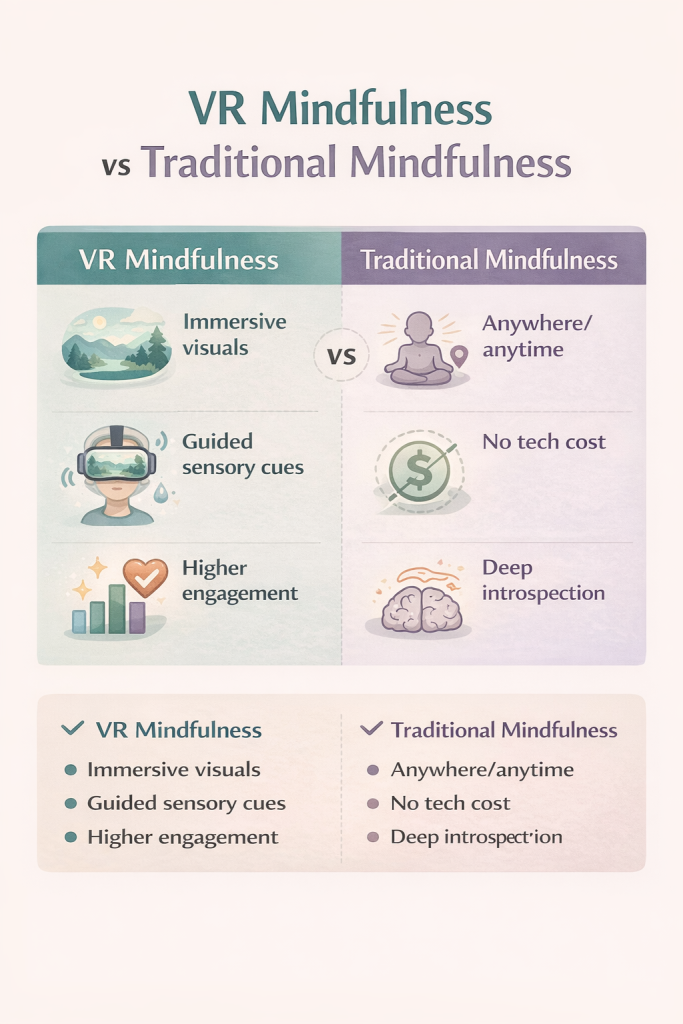
According to a study from JMIR Mental Health, in 2025, it talked about how VR-based mindfulness interventions, such as attention to user experience, show a bigger trend that VR can be acceptable to users and can help to support practice in people who are willing to keep doing it.
This might sound strange, but it’s a big deal. Using meditation in VR is great, but people who only do it twice won’t get the help that they need from it.
Some people also say that VR interventions might show more engagement and there might be lower dropout rates compared to traditional mindfulness techniques, but this is still being studied, according to PMC.
Mood and Anxiety Changes
A study in Nature Humanities and Social Sciences Communication in 2025 showed that there is evidence that using VR-based mindfulness interventions could help to get rid of things like anxiety and depression symptoms. This was a study done in a university that used qualitative feedback.
There are also some trials that show that VR-based approaches can reduce anxiety and negative moods while increasing mindfulness in students, according to Science Direct. This shows us that there are studies that show that there can be short-term improvements in mood after using relaxing interventions, and not just mindfulness. It’s important to find out if VR mindfulness can make real changes in coping, attention, and daily life.
Frontiers in Public Health did a review in 2025 that focused on whether VR can help to increase mindfulness, and they studied things like health status, mood, intervention duration, and other measurement tools.
What they found was that VR meditation is proven, and the research is enough to show that the design details matter in how much it’s going to help a person. If you are going to buy a VR, you shouldn’t just ask if VR mindfulness works, but find out which VR mindfulness will work for your goals.
Cognitive Changes People Pay Attention To
When researchers look at whether VR can actually support mindfulness, they focus on outcomes that line up with real mindfulness skills, not just whether someone felt relaxed in the moment.
One of the biggest areas is attention and distraction recovery. Mindfulness trains the ability to notice when attention drifts and bring it back. VR might help with this by narrowing the sensory field and making the anchor easier to notice. When there’s less competing input, it can be simpler to realize, “I wandered,” and return.
But there’s an important catch. VR is still novel for most people, and novelty grabs attention all by itself. If a VR experience is too beautiful, overly interactive, or gamified, attention can get absorbed rather than trained. In that case, you’re not practicing coming back; you’re just being held by the stimulus.
A helpful way to tell the difference is surprisingly simple. After a VR session, notice what happens in real life. When your mind drifts later in the day, is it easier to bring your attention back? Or did you just enjoy ten peaceful minutes inside a headset? That question gets to the heart of whether a skill was practiced or whether the calm stayed contained inside the experience.
Emotional Regulation
Some VR mindfulness and VR nature relaxation research shows that reduced anxiety and stress, as well as fewer negative moods, were observed in the short term for certain groups studied, according to ScienceDirect.
The best effects are the ones that happen after the session is over, when someone is dealing with things that trigger them, like crowds, arguments, medical waits, and notifications. Interpretation is the key, and early findings support that there is a chance that this can bring stress and mood benefits, but VR mindfulness should never replace medication, therapy, or the need for clinical help.
Interoception
Mindfulness doesn’t just happen in your head; it focuses on interoception. This is when you’re able to notice what’s going on inside your body. This can be your breathing, heartbeat, muscle tension, or changes in sensations that you might normally ignore.
VR can help you to be more aware of these things by offering guided cues and visuals like breathing lights or slow and rhythmic movement. It can also work against interoception, though if the visuals are too stimulating. When a scene needs attention, focus gets pulled outward instead of inward, like it needs to be.
Of course, VR is most effective when the experiences are least cinematic. Environments that aren’t as exciting work better than the ones that are dramatic. When there’s nothing competing for attention, it’s easier to feel yourself breathing instead of watching something exciting happening on the screen.
Why Measuring Mindfulness Is Tricky
Mindfulness is notoriously hard to measure. Most studies rely on self-report questionnaires, mood scales, and short follow-up periods. That doesn’t make the findings meaningless, but it does mean the results need context.
When a study reports improved mindfulness scores, that improvement might reflect relaxation, positive expectations, or satisfaction with the experience rather than a lasting change in skill. Researchers are actively working on better ways to measure mindfulness, but for now, it’s wise for readers and consumers to approach big claims with calm skepticism instead of blind enthusiasm.
Four Real-World Ways VR Mindfulness Shows Up
These examples focus on how VR is used, not on promoting specific products or platforms.
Example 1: When Eyes-Closed Meditation Increases Anxiety
For some people, traditional meditation backfires right away. Closing the eyes can trigger panic, intrusive thoughts, or uncomfortable body sensations that feel overwhelming rather than calming.
VR mindfulness can help by keeping the eyes open and offering a neutral anchor for attention, like a slow horizon, a breathing orb, or gentle spatial sound. This can make the first experience of staying present feel safer and more accessible.
The real test comes afterward. After a week of VR sessions, can the person practice for even two minutes in the real world without the headset? If yes, the tool did its job. If not, the skill may still be stuck inside the technology.
Example 2: Stressed Students Using VR Nature With Guidance
Students show up frequently in early research because they’re accessible and often dealing with stress, anxiety, and disrupted sleep. Many studies use a combination of calming VR nature scenes paired with mindfulness prompts, such as noticing the breath, labeling thoughts, gently returning attention, and scanning the body.
Some short-term trials report reductions in anxiety and negative mood, along with increases in mindfulness scores compared to control groups. The practical takeaway isn’t that VR replaces mindfulness practice. It’s that VR can serve as an on-ramp for people who struggle to sit still, focus, or get started at all, according to Science Direct.
Example 3: Working With Pain or Physical Discomfort
In certain contexts, mindfulness-based attention practices can help reduce suffering by loosening the mental loop between discomfort and fear. VR can create a highly controlled attentional environment, which may help some people practice non-reactivity to physical sensation.
This doesn’t mean VR removes pain. It means it may reduce the extra layer of suffering that comes from catastrophic thinking and emotional spiraling. The key distinction is intent. VR shouldn’t be used to numb out. It works best when it’s used to practice noticing sensation without adding the mental story that intensifies it.
Example 4: Short, Repeatable Workplace Resets
Many mindfulness benefits come from consistency rather than long, intense sessions. VR can make short practices easier to repeat because the ritual is clear. Headset on. Scene loads. Practice begins.
A five-minute VR reset during the workday may help some people shift from high alert back toward baseline, especially if the session includes breath pacing and a clear transition back into work. Design matters here. The most effective micro-resets don’t feel like a vacation you’re abruptly pulled out of. They feel like something you can carry with you into the rest of your day.
Downsides of VR Mindfulness
It’s also important to talk about the downsides of using VR for mindfulness practices.
Cybersickness
Cybersickness, which can cause dizziness, disorientation, or nausea when using a VR, is a common downfall, according to research. The ACM study in 2024 showed that motion sickness issues in VR can cause symptoms such as sensory conflict.
Of course, there are debates on how to measure cybersickness, and there are tools like Simulator Sickness Questionnaires and discussions on VR revisions that have been done according to Frontier.
When looking at this from the perspective of mindfulness tools, cybersickness can be present and can make people feel that they are going to throw up, which makes them present, but most people don’t want to deal with this.
VR mindfulness works best when there is less movement, the frame rate is stable, and the scenes don’t have a lot of movement.
When Sensory Overload Becomes the Distraction
A visually stunning VR world can turn into attention candy. When a scene is packed with animals, sparkles, movement, and cinematic moments, the brain often slips into entertainment mode instead of practice mode. Attention gets captured, not trained.
Mindfulness asks you to notice. Some VR designs mainly ask you to watch.
A simple check-in helps here. If you finish a session thinking, “That was beautiful,” but you can’t describe what you were practicing, the experience was probably relaxing, not skill-building. Relaxation has value, but it isn’t the same thing as mindfulness.
Using VR to Escape or Disappear
Mindfulness can feel uncomfortable at times because it asks you to stay with what’s real, including emotions you’d rather avoid. That discomfort is often where the learning happens.
VR can be a supportive tool in this process. It can also quietly turn into an escape hatch. If every time discomfort shows up, you reach for the headset and leave your body for a soothing digital environment, the practice shifts.
This is where it helps to be honest. If VR becomes your only way of coping, it’s no longer mindfulness. It’s avoidance, just dressed up with better graphics.
Meditation and Adverse Effects
Even some people who aren’t using a VR can have meditation effects like distress. This can happen for those who have mental health issues or trauma histories. According to the NCCIH, there is evidence that negative experiences can affect a minority of people, and it’s important to make sure that they are using safety precautions and care when doing VR mindfulness.
Using a VR can increase this for some people because it can cause them to have more intense emotions or bodily sensations that they aren’t used to. This doesn’t mean that VR mindfulness is unsafe for everyone, but it needs to be looked at with the right caution, especially in people who know mindfulness has triggered things in their past, such as dissociation, anxiety, or panic.
VR Meditation and Design
If the VR is the system that is delivering the help, then small choices can change the outcome. Mindfulness training benefits when there are fewer surprises, and VR mindfulness works best when the scenes are:
- Easy to predict.
- Have fewer moving objects.
- Low on the tasks that need to be done.
- Low on the sound changes.
This should be quiet and not exciting.
Why a Clear Anchor Matters
A clear anchor is everything. A breathing guide, gentle visual pacing, spatial sound, or a simple focal point gives attention somewhere to return. Without that, the mind naturally drifts into sightseeing mode. You’re still inside the experience, but you’re no longer practicing anything.
Mindfulness works because attention wanders and comes back. If there’s nothing to come back to, the skill never really gets exercised.
Transitions Matter More Than You Think
One of the most common complaints about VR mindfulness is the crash afterward. People feel calm in the headset, then pull it off and feel slammed by reality.
Better-designed experiences include a transition phase. Even a single minute of grounding can help bridge the gap. Feeling your feet on the floor, noticing the room you’re in, or choosing one simple intention for the next hour helps the nervous system reconnect instead of snapping back abruptly. That transition is often what determines whether the calm carries forward or evaporates.
Comfort and Accessibility Aren’t Optional
Comfort isn’t a bonus feature. It determines whether the tool is usable at all. Seated modes, adjustable brightness, and reduced-motion options matter.
A mindfulness tool that causes nausea defeats its own purpose. It’s like trying to practice yoga on a mat that gives you splinters. If the body feels unsafe or uncomfortable, attention won’t settle.
Where Intuitive Practices Fit, Without the Hype
Mindfulness is often described as training attention. Many people who value intuitive practices describe intuition in a similar way: noticing subtle cues, inner signals, emotional shifts, and patterns without immediately forcing them into a rigid story.
That overlap helps explain why some people naturally pair mindfulness with spiritual or intuitive routines. They aren’t always looking for supernatural certainty. Often, they’re just trying to listen to themselves with less mental noise.
In that context, VR mindfulness can function like a modern quiet room. Some people use a short VR breathing session before journaling, pulling tarot cards, or even doing online psychic readings. Not because VR proves anything paranormal, but because a calmer, more centered state makes reflective practices feel clearer and less reactive.
A responsible bridge here is simple and grounded. Mindfulness supports discernment. Discernment matters whether you frame your insights as psychology, spirituality, or intuition. A grounded approach doesn’t require claiming perfect prediction. It focuses on meaning-making, reflection, and choice, using guidance as a mirror rather than a command.
Tips for Using VR Mindfulness Safely
These are general suggestions, not medical advice. Anyone with medical concerns like seizure disorders, severe vertigo, or panic symptoms should talk with a clinician before using VR.
- Start shorter than you think you need. Three to five minutes is plenty at first. The goal is repeatability, not intensity.
- Choose seated, low-motion experiences. Avoid artificial walking or fast camera movement. Motion sickness can shut down both relaxation and learning very quickly, according to ACM.
- Pick simple environments. A plain beach often works better than a fantasy forest filled with fireworks. Your mind already has excellent special effects.
- Define your purpose before you start. Ask yourself whether you’re practicing mindfulness or seeking relief. Both are valid, but they’re not the same thing. If you want skill-building, choose an experience that emphasizes returning to an anchor, noticing distraction, and ending with a clear carryover intention.
- Track what carries forward, not just how it felt. After the session, ask yourself a few simple questions. What did I practice? Where did my attention drift? Was I kinder to myself than yesterday? Did I recover from stress more easily later?
If the only answer is “I’m not sure, but it looked cool,” you probably experienced relaxation, not mindfulness training. Relaxation is useful. Mindfulness just asks for a little more awareness than that.
What to Look Out For
If you notice these things, stop VR mindfulness and recalibrate what you’re doing:
- Anxiety that doesn’t go away.
- Feeling unreal.
- Dizziness that doesn’t stop.
- Wanting to avoid your life.
Meditation-related experiences can be positive and negative, and if they are positive, seek support or adjust what you’re doing.
Final Thoughts: VR Can Make Things Feel Real
VR can help make things seem real, and it can stimulate things like a quiet place, presence, and guided structure. This helps people to be able to pay attention to what they need. According to Nature+2ScienceDirect+2, research shows that these things can change into short-term improvements in stress, mindfulness, and mood for some people, and evidence shows that ongoing work is going to keep happening to see what kind of help works best for the individual.
The thing is, though, VR cannot simulate what you need, such as your willingness to get your mind to return to a peaceful state without bullying yourself because of your thoughts or mistakes. Remember, you are a human being.
If you use VR to help you be more mindful, it can be used as a great tool, but if you use it as a mindfulness vacation, it can feel good, but it won’t give you the skills that you need when life is hard.
The best way to do this is to use VR for mindfulness practice when things are hard in your life. The goal isn’t to replace traditional mindfulness practices but to expand them. By being honest and staying slightly skeptical, you can use the headset to help you grow.



While the concept of VR mindfulness sounds appealing, I worry it’s just another tech gimmick. Can a headset really replace traditional methods? Seems like an easy way to avoid real emotional work.
I disagree with the notion that VR can enhance mindfulness without genuine effort from the user. Mindfulness is about self-awareness and intention, not just technology. Using VR as a crutch isn’t real progress!
‘Mindfulness vacation?’ That’s a comical way to put it! Sometimes I wish life came with an ‘undo’ button like those VR experiences. But hey, reality has its charm too!
Indeed! It’s all fun and games until you realize that avoiding real-life problems doesn’t help in the long run. We need both relaxation and engagement with our feelings.
The practicality of using VR for mindfulness is intriguing but must be approached cautiously. If not used mindfully, it risks becoming just another distraction rather than a tool for growth.
This article provides valuable insights into how VR can assist in mindfulness practices. It highlights both the benefits and potential downsides, such as cybersickness and overstimulation, which are critical to consider before diving in.
Absolutely! The balance between using technology effectively while still cultivating genuine mindfulness skills is crucial. It’s important that users remain aware of their intentions when using VR tools.
‘Using VR to escape or disappear’—what a thought-provoking phrase! This makes me chuckle because I often think of my phone as my ‘escape device.’ We have to be careful about what we use for relaxation! 😅
I found this article fascinating! The potential of VR in enhancing mindfulness practices is incredible. It’s like having a personal retreat at your fingertips! I can’t wait to try it out for myself. 🌟
Wow, this sounds like something straight out of sci-fi! A virtual reality world where you can practice mindfulness? Count me in! Just hope it doesn’t end up making me dizzy or lost instead!