

There is no universal schedule for psychic readings. Some people seek a spiritual check-in around a life change; others prefer occasional reflection. A better guide than a calendar is whether the next session has a clear purpose and whether you have had time to use what the last one offered.
You can value a reading without needing to repeat it whenever uncertainty returns. Let the conversation become part of your life through reflection and a practical step, rather than another question to check immediately.
Give yourself time to integrate the last reading
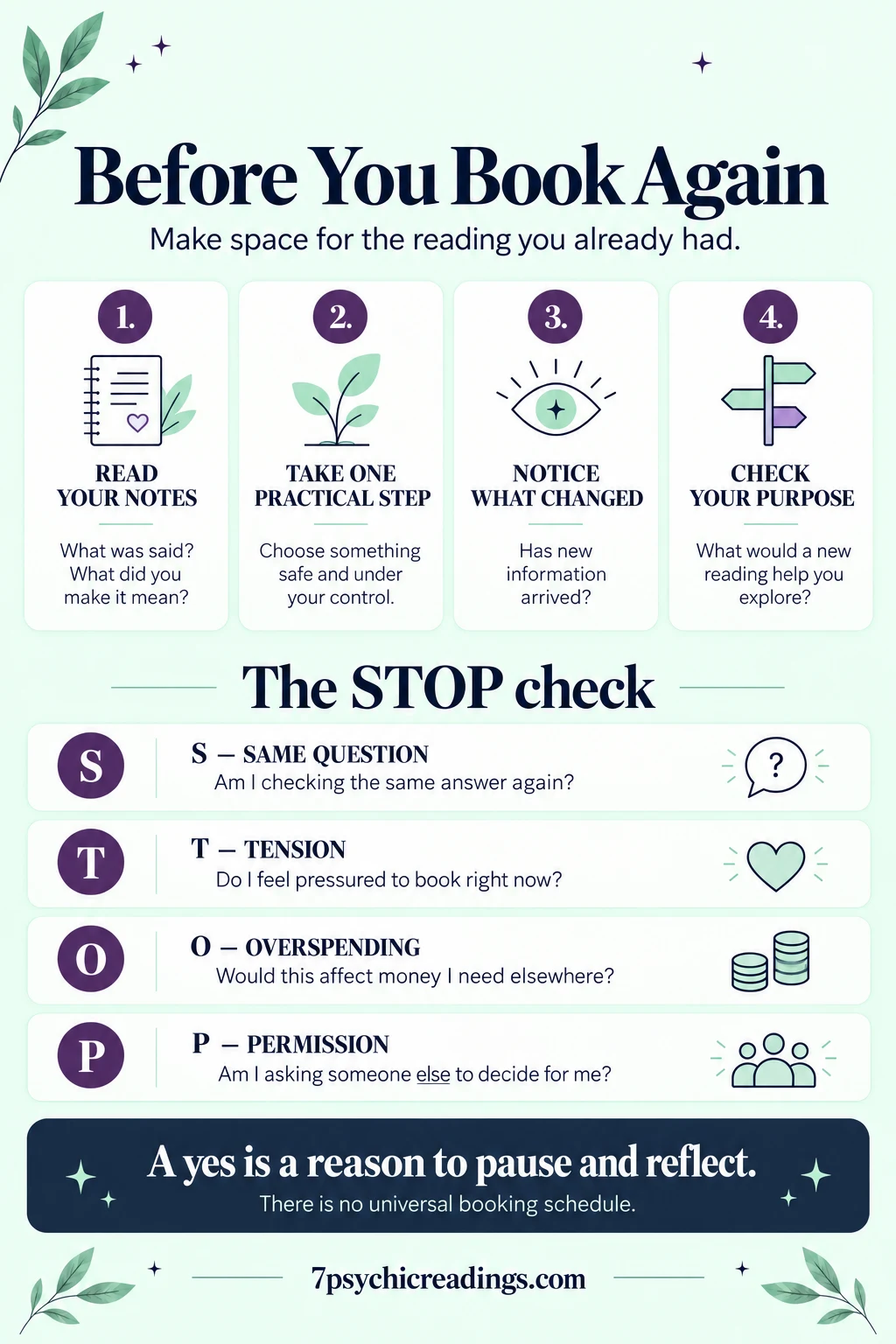
An integration period is simply space to think and act. It might be short or long depending on the question. You do not need to wait for every interpretation to resolve, but you should have a chance to distinguish the reader’s words from your own expectations.
- Review: What did the reader actually say?
- Act: What manageable step makes sense regardless of a prediction?
- Observe: What new information came from that step?
- Reconsider: Is there a different question worth discussing?
After a career reading, for example, you might compare course requirements or contact someone in the field. Their response adds information you can use. Another session before that step may simply revisit the same uncertainty. Our psychic reading aftercare guide offers ways to reflect on a session.
Use the STOP check
STOP is a reminder to examine your reasons for booking. It is not a diagnostic test or a score that determines how often everyone should have readings.
| Check | Ask yourself | A useful response |
|---|---|---|
| S — Same question | Am I checking the same answer again? | Review the original notes and identify what is actually new. |
| T — Tension | Do I feel pressured to book right now? | Step away from the booking screen and return when you can choose freely. |
| O — Overspending | Would this affect money I need elsewhere? | Keep the spending limit you set before the urge appeared. |
| P — Permission | Am I asking someone else to decide for me? | Write your options and the information you need to choose. |
Match the timing to your purpose
| Purpose | What might make a later session useful? | A reason to wait |
|---|---|---|
| Broad reflection | A new stage, priority or theme | The previous themes still give you enough to explore. |
| A practical decision | New facts after research or a conversation | You have not yet taken the next practical step. |
| Relationship guidance | A change in your own question or circumstances | You are repeatedly checking another person’s feelings. |
| Spiritual enjoyment | You freely want the experience within your budget | It feels compulsory or interferes with everyday responsibilities. |
A new mood is not always a new question. Ask what you hope to understand and whether reviewing your notes, journaling or speaking with someone involved would serve that need first.
Set both a spending limit and a topic limit
A monthly allowance can help, but it may still allow the same relationship question to be asked repeatedly. Consider a second rule: do not revisit that topic until you have new information or have carried out the step you chose.
Choose any spending limit from money genuinely available after your responsibilities. The CFPB’s budgeting tools include income and spending trackers that can help you see the full picture. A reader’s recommendation to book more often does not expand your budget.
If spending affects shared household money, agree on boundaries together. You can keep the content of a spiritual conversation private while being clear about the use of shared funds.
Notice when another answer creates more checking
It can be tempting to consult a different reader after an answer disappoints you. Compare the purpose carefully: are you seeking a different approach, or trying to keep asking until someone offers certainty?
Several confident but conflicting answers may leave you with more questions. Write down what you already know and what remains uncertain. Our guide to free will and psychic predictions can help separate a claim from the choices still available to you.
Create a pause you can actually keep
You might choose a personal cooling-off period, move an app off your home screen or remove saved payment details. These are optional ways to create space, not a medical treatment or a universal rule.
During the pause, pick one activity: reread the notes, take a walk, talk with a trusted person, research an option or write what you would do under either possible outcome. The aim is to regain room to choose, not to punish yourself for wanting comfort.
When a longer break makes sense
Pause if bookings are causing debt, secrecy, lost sleep or missed responsibilities. You do not need to keep paying because someone claims that stopping will bring harm, remove protection or break a spiritual connection.
If distress or spending feels difficult to control, support from someone you trust or an appropriately qualified professional may help. A psychic practice can remain meaningful while no longer being the first response to every uncertain moment. Book again only if you freely choose it and can explain what it adds.
Frequently Asked Questions
1. Is there a correct number of readings per month?
No universal number suits everyone. Consider purpose, spending, wellbeing and whether you have used the previous session.
2. Should I book again immediately after a reading?
You do not have to. Review your notes and allow time to reflect before deciding.
3. What is an integration period?
It is time to review the reading, take a practical step and notice what you learn before another appointment.
4. What does STOP stand for?
Same question, tension, overspending and permission: four reasons to examine the urge to book.
5. Does a yes on STOP diagnose a problem?
No. It is a reflection prompt and a reason to pause, not a clinical assessment.
6. Can I get a second opinion from another reader?
Yes, if you freely choose it. Be clear whether you want another approach or are repeatedly seeking a reassuring answer.
7. Should I repeat a question until predictions agree?
Agreement does not establish certainty. Review what can be checked and what remains unresolved.
8. Is a monthly limit enough?
It can help with spending. A topic limit can also prevent repeatedly revisiting the same unresolved question.
9. How do I choose a spending cap?
Look at money available after your responsibilities and set the limit before booking. Do not increase it because of pressure during a session.
10. Must I have a reading every time I notice a sign?
No. You can reflect privately or leave the experience open without paying for an interpretation.
11. Can I wait until I have new information?
Yes. A conversation, application result or practical step may change what you want to ask.
12. Does taking a break reject my psychic beliefs?
No. Belief and a deliberate booking boundary can coexist.
13. What if a reader says stopping will cause harm?
You can stop. A threat is not an obligation to buy another service.
14. What can I do instead of booking impulsively?
Review your notes, write your options, do a manageable task or speak with someone you trust.
15. When should I seek more support?
Consider appropriate support if distress, spending, secrecy or repeated bookings interfere with daily life.