

Psychic reading aftercare means giving yourself space to reflect after a reading instead of looking at every statement right away. A reading can leave you feeling encouraged, emotional, uncertain, or a mixture of all of them. You don’t have to decide that the meaning is complete before you go back to your regular life.
If you believe in spiritual guidance, a good reading might feel personal. This feeling needs attention, but it should also remind you that emotional intensity doesn’t mean predictions are accurate. An interpretation can still feel meaningful while there’s uncertainty.
Useful aftercare is easy, such as taking time to pause, keeping good records, seeing what you know, and then picking an action step to take. You can keep your spiritual feelings without looking at the reader as authority over your relationships, finances, or future.
The steps below are practical reflection suggestions. They are not a treatment plan or a promise that nothing difficult will happen.
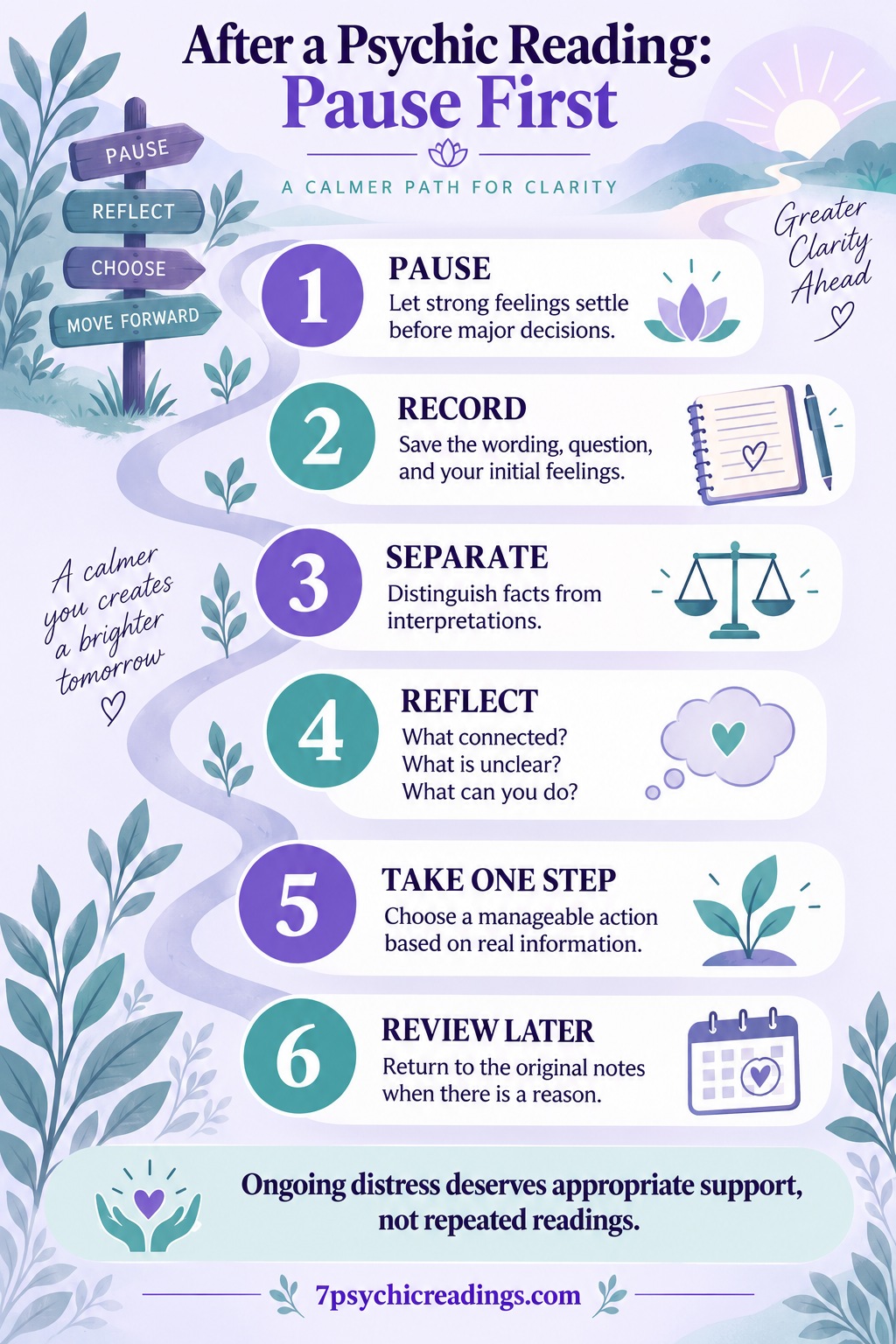
Read the infographic as text
- 1. PAUSE: Let strong feelings settle before major decisions.
- 2. RECORD: Save the wording, question, and your initial feelings.
- 3. SEPARATE: Distinguish facts from interpretations.
- 4. REFLECT: What connected? What is unclear? What can you do?
- 5. TAKE ONE STEP: Choose a manageable action based on real information.
- 6. REVIEW LATER: Return to the original notes when there is a reason.
Ongoing distress deserves appropriate support, not repeated readings.
Take a Pause
After the reading, allow more time before you start another reading or send an emotional message. Take a short walk, get a drink of water, or do a household task to change your attention. Pick something comfortable instead of something that makes you feel obligated to perform perfectly.
If you’re using a spiritual closing practice, keep it voluntary. You can put away a tarot card deck, light a lamp, or write down a sentence about what you want to reflect on. Don’t do practices that create new fears, such as believing that you have to cleanse right away or that a harmful prediction will follow you.
Pay attention to your immediate state without interpreting every feeling. Feeling sad after a discussion of grief doesn’t mean that there’s a spiritual presence. Feeling excited after a good prediction doesn’t mean that it’s going to come true. You can acknowledge the experience without deciding the cause.
If you’re doing a phone or chat reading, look at the closure too. Confirm that the reading has ended, that the billing is stopped, and that any notes are accessible. Resolve these details so that they don’t get mixed with emotional content.
Writing Down Messages
Save the written reading to make notes on the regular statements. Find out the exact wording from your summary, and if you’re not sure, use things like “I remember the reader suggesting this” instead of putting an uncertain memory in quotation marks.
Write down the question you asked and the information you shared with the reader. This helps you see whether the response talked about your concerns. It also stops a later event from making the reading look more specific than it was.
Keep feelings separate. You might say, “The reader suggested a possible change would happen at work. I felt hopeful because I wanted to switch roles.” Both of these parts matter, but they are different kinds of information.
You don’t need to write down every word. To benefit from the aftercare, a few good notes can be enough. If recordings are involved, follow the reader’s policy, get consent, and look at local requirements before you share a recording.
Facts from Interpretations
Take time to read the notes and ask what you knew before the reading. Maybe your partner had already asked you for space, or your employer had announced a restructuring of the company. These are facts that are part of the foundation for making decisions.
The reader statements can add symbolic themes, guesses, or predictions, but you need to make sure this is known. They might say something like, “The card suggests distance,” which is an interpretation, and “My partner asked me not to contact them anymore,” which is a fact and a statement from the person involved. This kind of reading doesn’t take over boundaries.
NHS guide to reframing unhelpful thoughts encourages checking evidence and considering alternative perspectives. That general skill can be helpful when a reading triggers a strong assumption. It does not judge the spiritual meaning of your experience.
Give Hopeful Messages Some Thought Too
Positive predictions can be one of the most exciting parts of a psychic reading. Hearing that a new opportunity, relationship, or financial change might be coming can give you hope and help you feel more confident about what’s ahead. At the same time, you can enjoy that encouragement while continuing to make practical choices in your everyday life.
If a reading points toward a new job or career opportunity, use that positive energy to keep moving forward. Update your resume, apply for positions that interest you, or prepare for an interview. You don’t have to stop taking action while you wait to see how the prediction unfolds.
The same idea can apply to love. A reading might show the possibility of a new relationship, reconciliation, or positive change in your love life. You can stay open to that possibility while still paying attention to what’s happening around you and allowing other people to make their own choices.
Financial predictions deserve some thought too. If a reading points toward abundance or more money coming into your life, enjoy the encouragement without just thinking that future money is already available to spend. Look at what you can comfortably afford right now, especially before making a large purchase or financial commitment.
One helpful question is, “Would this still be a good decision if things happen differently than expected?” Updating a resume or becoming more open to meeting someone new might still benefit you either way. This doesn’t mean that you have to doubt the reading. It just helps you make decisions that support you while giving the prediction time to unfold.
Take Your Time with Messages That Feel Scary
Some readings can include difficult messages about relationships, health, loss, or other situations that naturally bring up strong emotions. If something in a reading frightens you, give yourself time to process what was said before making a major decision.
If the reading brings up a health concern and you’re experiencing actual symptoms, talk with an appropriate medical professional. If it brings up something involving safety, take any real signs of danger seriously and get the appropriate help. Spiritual guidance can still have a place in your life while medical, legal, or safety concerns receive the kind of support they need.
The same care can help with relationship readings. If a reading brings up betrayal, dishonesty, or another difficult possibility, pay attention to what happens in the actual relationship before making an accusation. You can keep the message in mind while giving yourself time to see what connects with your situation.
Be especially careful if fear is immediately followed by pressure to spend more money. If someone tells you that something terrible will happen unless you purchase an expensive cleansing, another reading, or repeated spiritual services, give yourself time before agreeing to anything. Spiritual practices and cleansing can be meaningful, but fear shouldn’t be used to pressure you into spending money you weren’t planning to spend.
If something from a reading continues to bother you, talking it through with someone you trust can help. You can take the spiritual message seriously while still giving yourself room to process your emotions and decide what feels right.
Use an Easy Reflection Routine
After a reading, pick three questions that can help you think about what came through. What part of the reading connected most with the question you originally asked? What are you still wondering about? What is one thing you can do with the guidance you received?
For example, a career reading might help you realize that having more independence at work is important to you. You might still be waiting to see if the opportunity mentioned in the reading appears. In the meantime, you could research different positions, update your resume, or talk with your manager about taking on different responsibilities.
If dream work is part of your spiritual practice, you can also write down any dream images that remind you of something from the reading. Think about what the image means to you and how it connects with what came through. Dreams can add another meaningful layer to your reflection, especially when certain symbols or themes continue appearing.
Keep the process easy enough that you actually enjoy doing it. You don’t have to analyze every sentence from a reading immediately. Write down what stands out, give yourself time to think about it, and return to your notes later if something new happens or another part of the reading begins to make more sense.
Pick One Step to Begin With
A reading can cover several different parts of your life, and sometimes a lot of information can come through at once. You don’t have to make changes in every area immediately. Pick one step that feels useful and manageable and begin there.
That step might be having a conversation, writing in your journal, updating your resume, looking at your schedule, setting a boundary, or spending more time thinking about something that came through. One meaningful step can be enough to begin working with the guidance from your reading.
If a reading brings up several major changes, give each one the attention it deserves. Ending a relationship, leaving a job, moving somewhere new, or making a large financial decision can have long-term effects. Even when a reading feels powerful and meaningful, you can take time to think about each decision instead of changing everything at once.
Also think about the other people involved. If a reading suggests reconnecting with someone, that person still has their own boundaries and choices. If family members are discussed during a reading, their private information should still be respected. Spiritual guidance can help you think about your relationships without taking away another person’s ability to make their own decisions.
If the next step would be difficult to change later, gather the information you need before moving forward. You can give your psychic reading and spiritual beliefs an important place in the decision while also looking at the practical parts of the situation. The two don’t have to compete with each other.
Booking More Readings
You might get tempted to book another reading to confirm an answer that was hopeful or to cancel one that scared you. This can give you temporary relief, but a new interpretation can also cause more uncertainty. Costs can also come when the regular question stays unresolved.
Decide to take a pause that fits your budget and your situation. During this pause, don’t ask different readers for a new reading, but keep the regular notes and focus on the information you can get from your regular life.
If you do go back to getting a reading, think of the different kinds of questions you can ask, such as, “What can I reflect on about setting boundaries?” This could be better than repeatedly asking if someone who left you is going to return. A change question should have a real purpose and not just be there for reassurance.
You can decide that the reading format doesn’t suit you. Some people like written responses, and others like live conversation. Others will take longer breaks, and the choice is yours and doesn’t need anyone else’s approval.
Privacy
Keep readings at a level of sensitivity you’re comfortable with. If you share a device with someone, open an email account, or use a public cloud link, it might show information about the relationship or your health. Look at access before saving or forwarding any materials.
FTC's guidance on securing personal information offers practical account-security advice. For reading notes, use secure accounts and avoid sharing more detail than needed. Think carefully before entering private material into a chatbot or another service with different data policies.
If you want to talk about the reading with a friend, write down the reflection instead of wording the full transcript. Take out details that show what people who didn’t participate in the reading did. A good conversation doesn’t mean that you have to make everyone’s private life known.
Keep complaints separate from service problems. Accurate records of charges, promises, and communication can be helpful through support channels. Privacy and practical documents can work together.
Getting More Aftercare
Regular self-care can support your well-being, but if you’re feeling a lot of stress, you need more help. If reading leaves, you are unable to function, sleep, or feel safe, talk to a qualified healthcare professional or a local support service. You can talk about what triggered you without needing to share your spiritual beliefs.
NIMH's mental health guidance describes everyday care and seeking help for significant symptoms. It is general health information. A psychic reader should not diagnose or treat an ongoing mental-health problem through repeated sessions.
If you’re in danger or feel unable to keep yourself safe, get urgent local emergency care or crisis support. Don’t wait for the readings to get clear. Take safety as your priority over interpretation.
You can go back to spiritual reflection later if you want to. Getting support doesn’t mean you abandon your spirituality, but it just allows things to be addressed.
An Easy Example of Giving a Reading Time to Settle
Imagine Priya receives a reading that suggests a friendship could be entering a period of distance. The message catches her off guard, and at first, she wants to immediately send her friend a message asking what’s wrong. Instead, she gives herself a little time to think about what came through during the reading.
Priya writes down the message so she can return to it later. She also thinks about what has been happening in the friendship lately. Her friend has been busier than usual, but they haven’t had an argument, and nothing has happened that clearly suggests the friendship is ending.
Instead of sending an upset message, Priya decides to reach out with a normal invitation when the time feels right. She can still keep the reading in mind and pay attention to how the friendship develops without just thinking that distance automatically means rejection or the end of the relationship.
The reading also gives Priya something more to think about. She starts considering the other friendships in her life and if there are people, she would like to spend more time connecting with them. What came through during the reading becomes something she can reflect on instead of something she feels pressured to react to immediately.
This is one-way psychic reading aftercare can be helpful. Give the reading some time to settle, think about the messages that came through, and notice how they connect with your life as time goes on. You can value the spiritual guidance you received while still giving situations and relationships time to develop naturally.
Some parts of a reading might make sense immediately, while others might connect more clearly later. There is no need to force every message to fit.
Final Thoughts: Looking at Notes
Pick a later time to review the reading if it raised something you want to think about again. Keep the reason specific, such as looking at a reflection after a conversation or checking a forecast when the stated window had passed. Don’t reopen the notes if you just feel uncertain.
If nothing needs to be reviewed, you can just save the reading and move on. A good reading doesn’t require continuous interpretation. Some reflections might be useful later, and others may never fit. You’re allowed to leave all of these aside.
When you do go back, read the original wording before you add your summary. Pay attention to any new information and any changes in your own thoughts or perspectives. It’s important to learn from the experience instead of searching for every event as proof that the reader was right.